- Client
- TOPPAN Digital Inc.
- Expertise
- DX Support
- Date
Overview
Goodpatch identified the challenges involved in TOPPAN Digital's transition from a culture and structure centered on contract development to an in-house SaaS product development structure, and supported the product's growth from both the development organization and business strategy sides. In Phase 1, Goodpatch built the foundations of the product management and product marketing organization; in Phase 2, it provided concrete product growth support for the proofing service "review-it! for Package." This is a case in which the product management mindset was rooted in the organization, establishing a foundation for realizing sustained business growth.
Client
TOPPAN Digital Inc.
Following the transition to a holding company structure in October 2023, TOPPAN Digital is responsible for driving the group's DX strategy. The company operates multiple products, including "review-it! for Package," a SaaS for streamlining proofing work, and aims to expand revenue.
Summary
Challenges before the engagement
- Knowledge depended on individuals, and a TOPPAN Digital way of product management had not been established
- The contract-development culture ran deep, creating a product development culture in which the intentions of current clients tended to take priority over the users who should truly be targeted
- A shortage of engineering resources made it difficult to polish the product
- North Star Metrics, the indicators for measuring growth, had not been established
- Product feature improvements were being impeded, with challenges in optimizing the agile development process
Goodpatch's approach and outcomes after the engagement
- Established a TOPPAN Digital way of product management process
- Built a foundation for product improvement through cross-organizational collaboration between PdMs (product managers; hereinafter "PdM") and PMMs (product marketing managers; hereinafter "PMM")
- Realized autonomy and self-direction through hands-on support for a junior PdM
- Fostered a customer-centered product development culture
- Established product metrics and built a foundation for data-driven decision-making
- Optimized the development process and realized autonomy and self-direction among development members
- Strengthened the linkage between business strategy and development strategy for the product
Organizational Transformation and Product Growth in Pursuit of Breaking Away from the Contract-Development Culture
TOPPAN Digital had set out a strategy of expanding its business domain from "contract development for individual companies" to "product development for the market." However, the company faced three challenges: insufficient organizational support for developing PdMs, the need to clarify the PdM role, and the need to strengthen UX in BtoB products. To solve these challenges, the work proceeded in stages, from building the organizational foundation to concrete product support.
Launching a PdM Committee for People with No PdM Experience
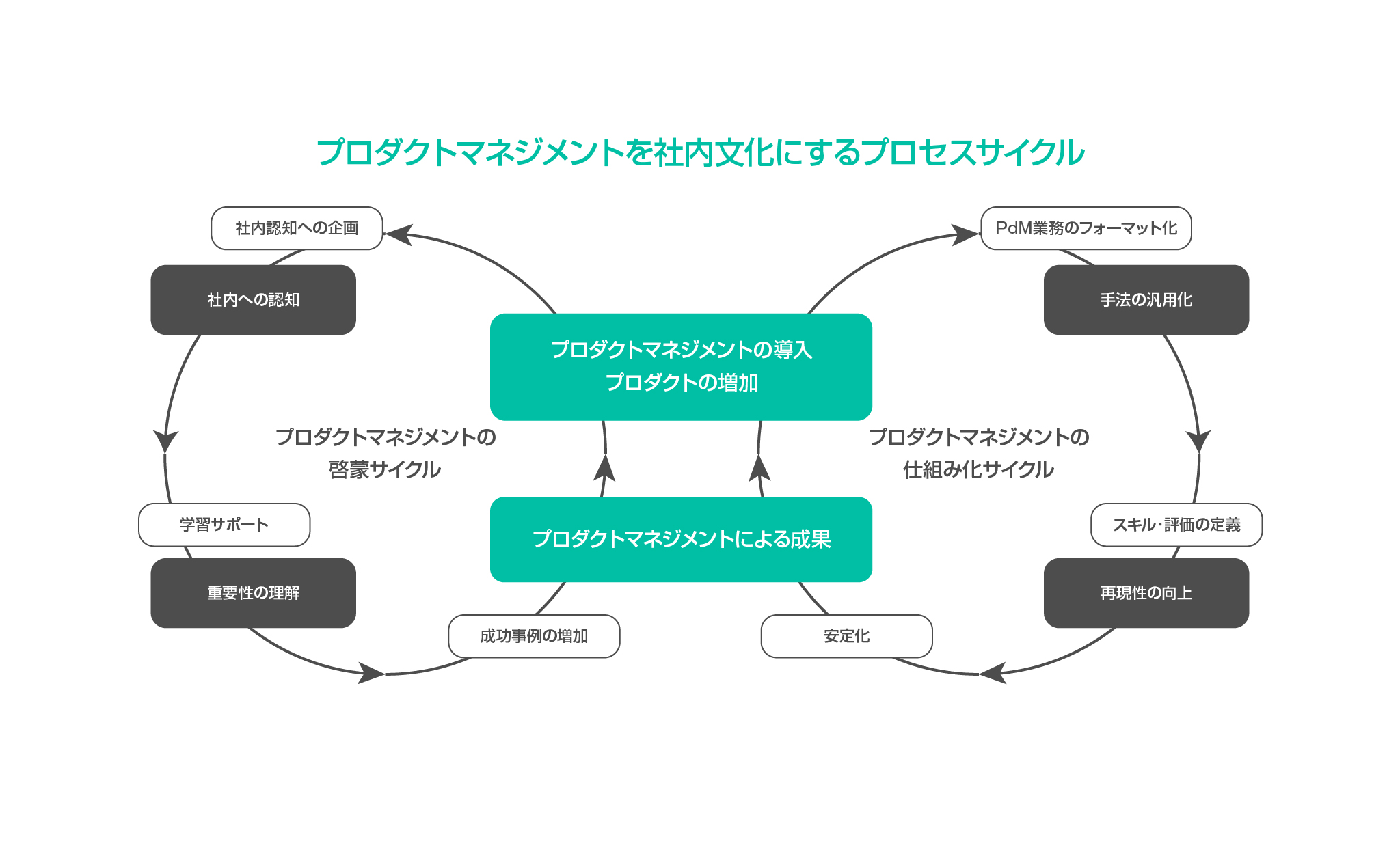
While dozens of products existed within TOPPAN Digital, only a handful of people had PdM experience. Product management knowledge inside the company depended on individuals; PdMs with development backgrounds tended toward product-centered thinking, while PdMs with sales backgrounds tended toward revenue-centered judgments.
To improve this situation, a "PdM Committee" was launched targeting people within TOPPAN Digital with no PdM experience. Through repeated interviews and surveys with organizational managers and frontline members, the committee's mission, vision, and activity roadmap were formulated. In particular, "PRD creation" and "medium-to-long-term roadmap creation" — tasks often required of PdMs at TOPPAN Digital — were conducted in workshop format.
Establishing TOPPAN Digital's Own Product Management Process
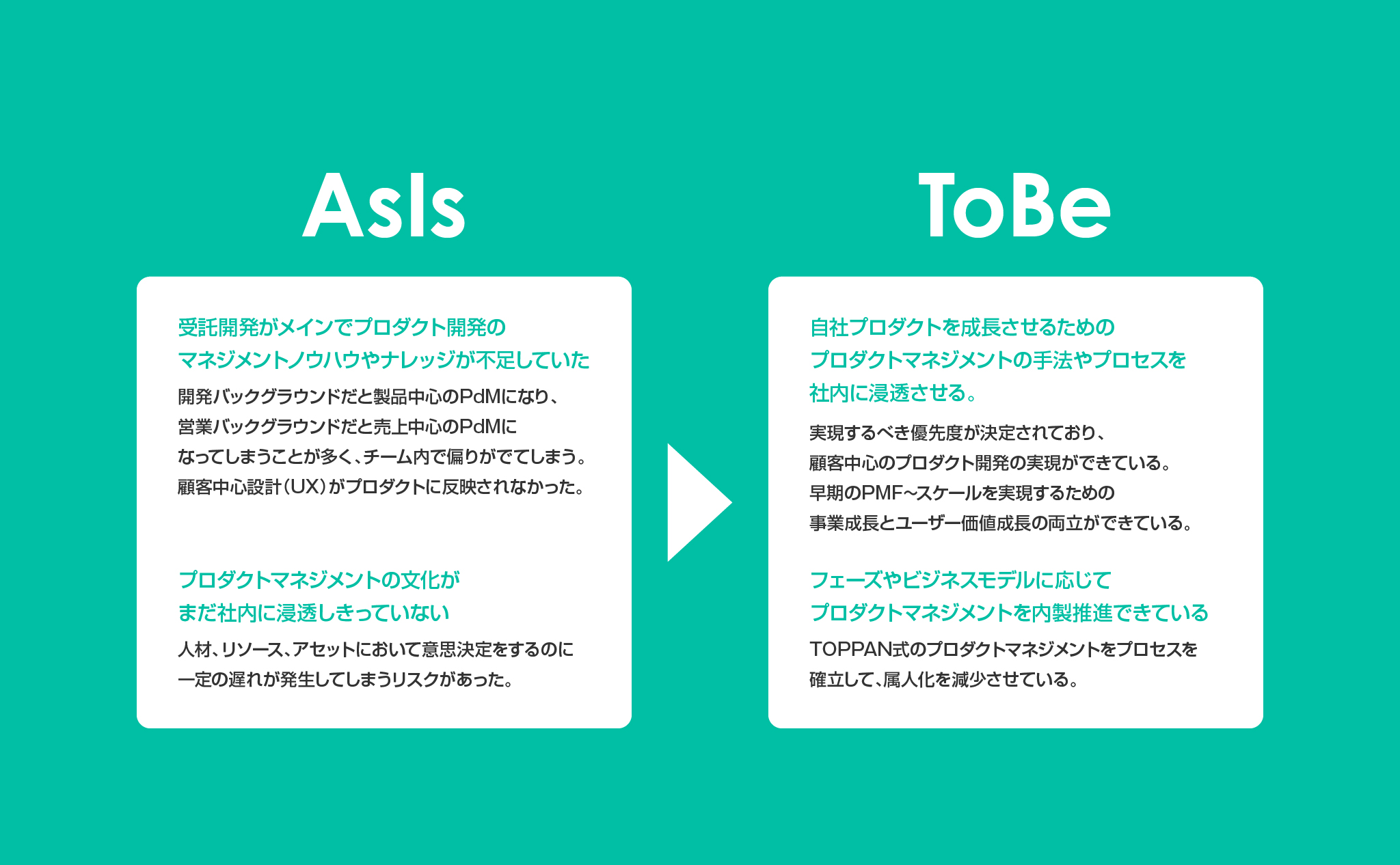
Through the committee's activities, the "As Is" (current state) and "To Be" (ideal state) of the product development front lines were defined, and the issues creating the gap between them were structured. Through this, the team aimed to establish TOPPAN Digital's own product management process.
Participating members voiced concrete realizations, such as: "We had supposedly decided our MVV and personas, but the shared understanding within the team was starting to drift — the personas had already changed — and I reconfirmed the necessity of a PRD," and "I want to think about the product in terms of the value broken down from the product vision and the impact it will have on users."
Defining the PMM Function and Domain, and Strengthening the Structure
In parallel with the PdM Committee, the team advanced the articulation of the PMM function and domain, defining the ideal PMM for TOPPAN Digital. At the time, the PdM's scope of responsibility within TOPPAN Digital was too broad, so it was first necessary to put the PMM's function and domain into words and establish a clear division of roles between PdM and PMM. In particular, because a PMM role focused more on customer success was needed in place of the traditional sales-led approach, the team raised the philosophy of "from client-first to success-first," articulating and redefining the PMM's function and domain. The background to why this articulation was needed: PMMs were still few in number within the company, and their work was often carried out in individualized ways within each product team, so no unified framework existed across the organization. With different strategies unfolding for each product, the lack of clarity in the PMM role created the problem that efforts to accelerate product growth were scattered. Clear articulation — clarifying the role the PMM should play and building a shared understanding across the organization — was urgent.
The team therefore focused on visualizing the challenges PMMs face and deriving concrete solutions. First, the "As-Is / To-Be" states were organized with the PMM in charge, clarifying the gap between current duties and the ideal role. Weekly sessions of repeated interviews followed, with discussions to bridge the gulf between the business side and the product side. In particular, the work went as far as designing concrete business processes, such as "at what point should the PMM coordinate with the PdM" and "how should information be shared with sales and CS." Through these efforts, the team aimed to elevate the PMM function into a more strategic role while strengthening collaboration with PdMs. This foundation led to the PMM support for "review-it! for Package," and became a key to accelerating the product's growth.
Optimizing the "review-it! for Package" Product Team Structure and Strengthening Collaboration Between the Business and Development Teams
After building the organizational foundation in Phase 1, concrete product support began for the proofing service "review-it! for Package." Following the policy of spreading success stories by making one product a role model in order to embed the TOPPAN Digital way of product management, "review-it! for Package" was chosen: it had a certain number of customers and needed to be grown further. However, an engineer shortage meant resources could not be devoted to improving the product's features; day-to-day responses and urgent issues dominated, leaving insufficient resources for medium-to-long-term feature expansion and fundamental problem-solving.
Communication and coordination mechanisms among development team members were also not in place, and the structure for the whole team to work on product improvement was not functioning adequately. Although scrum development had been introduced, meetings and events tended to become formalities, and coordination between the PdM and the scrum master was limited, creating an environment where it was difficult to face the essential challenges of product development.
To solve these issues, the team first improved communication and structure, strengthening collaboration with the development and business teams. For the autonomy and self-direction of a junior PdM who had just changed jobs from CS, growth support was provided, starting with daily 1-on-1s. Through building the development team structure and redefining the purpose and reviewing the operation of scrum events — walking through the thinking process together while making improvements — a structure was built in which the PdM acts proactively and communicates with engineers.
Building a Foundation for Data-Driven Decision-Making
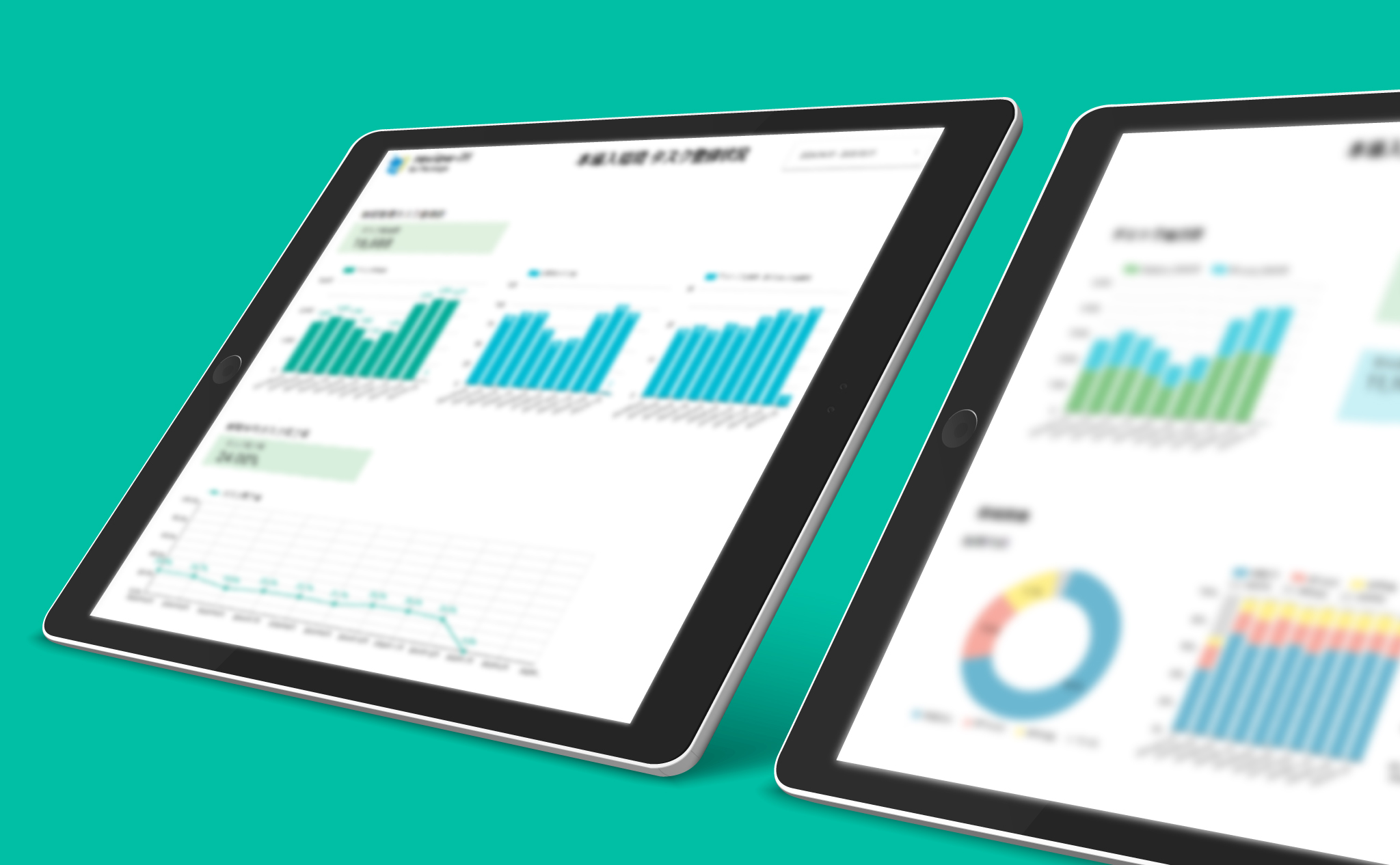
Starting from the product's "Aha Moment"* — the team defined NSM (North Star Metrics) and KPIs connected to the business KGI. A dashboard for collecting and analyzing product data was created, with support also provided on how to build it. *In product development, the moment a user experiences the product's value At the time there was a sales dashboard, but product numbers had not been visualized. The team therefore created a metrics tree, moving back and forth with the service's delivered value, and translated it into the dashboard.
In this process, the importance of setting indicators grounded in user experience also became clear. For example, when measuring "task completion rate," Seki-san of TOPPAN Digital, who comes from CS, conducted user interviews and discovered that some users, after checking visually, do not press the completion button. Discussions grounded in user experience like this led to indicator-setting and experience improvements more aligned with reality. As a result, the client is now able to constantly grasp the product's status in Looker Studio, visualize the data, and derive insights on their own.
Consistently Supporting Growth Through Mutual Collaboration Between Business and Development in Product Strategy
On the product development side, the PdM and tech lead led problem-solving meetings dedicated to scrum operation, redefining each event with retrospectives at the center. By continuing to improve while operating, the team created a path from reflection to results. Through improving the operation of the product backlog, the hub of communication, collaboration among the PdM, the scrum master, and the entire development team was strengthened.
On the product strategy side, the PMM first defined the STP, starting by creating the strategic groundwork such as the product vision and positioning map. The initial plan was to start from metrics visualization, but the team reached the conclusion that numbers are meaningless without a vision attached, and flexibly changed course. It was decided to first hold a workshop for vision formulation. In this workshop, the abstract vision that had existed until then was reexamined, and the team worked on building a vision that is more practical and that everyone can empathize with. With concrete input on customer voices from Seki-san of TOPPAN Digital, who comes from CS, a simple, easy-to-understand, "flesh-and-blood product vision" was completed — one that everyone involved can recognize in "their own words."
What deserves special mention is that the concept of MVV (mission, vision, values) — previously thought of as "visions are emotional things" — was fundamentally reexamined and finished into something that allows unwavering interpretation when thinking about strategy, with clarity for newly joining members also taken into account. This deepened team members' attachment to the vision and raised its resolution. In the course of this vision formulation, the team also worked on creating a "value map," ultimately visualizing what kind of experiential impact the vision could deliver. The many elements that had been in chaos were brought into order.
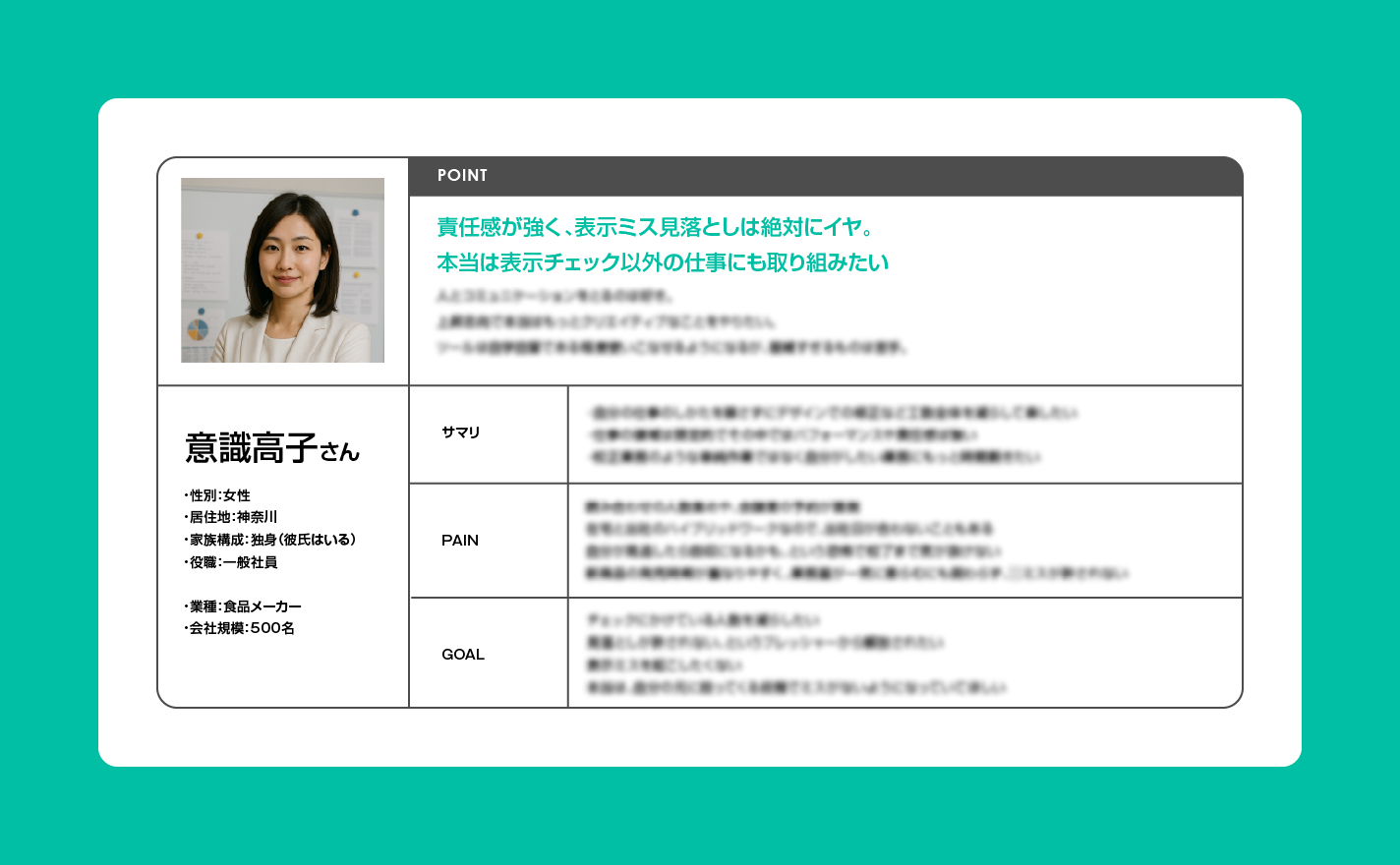
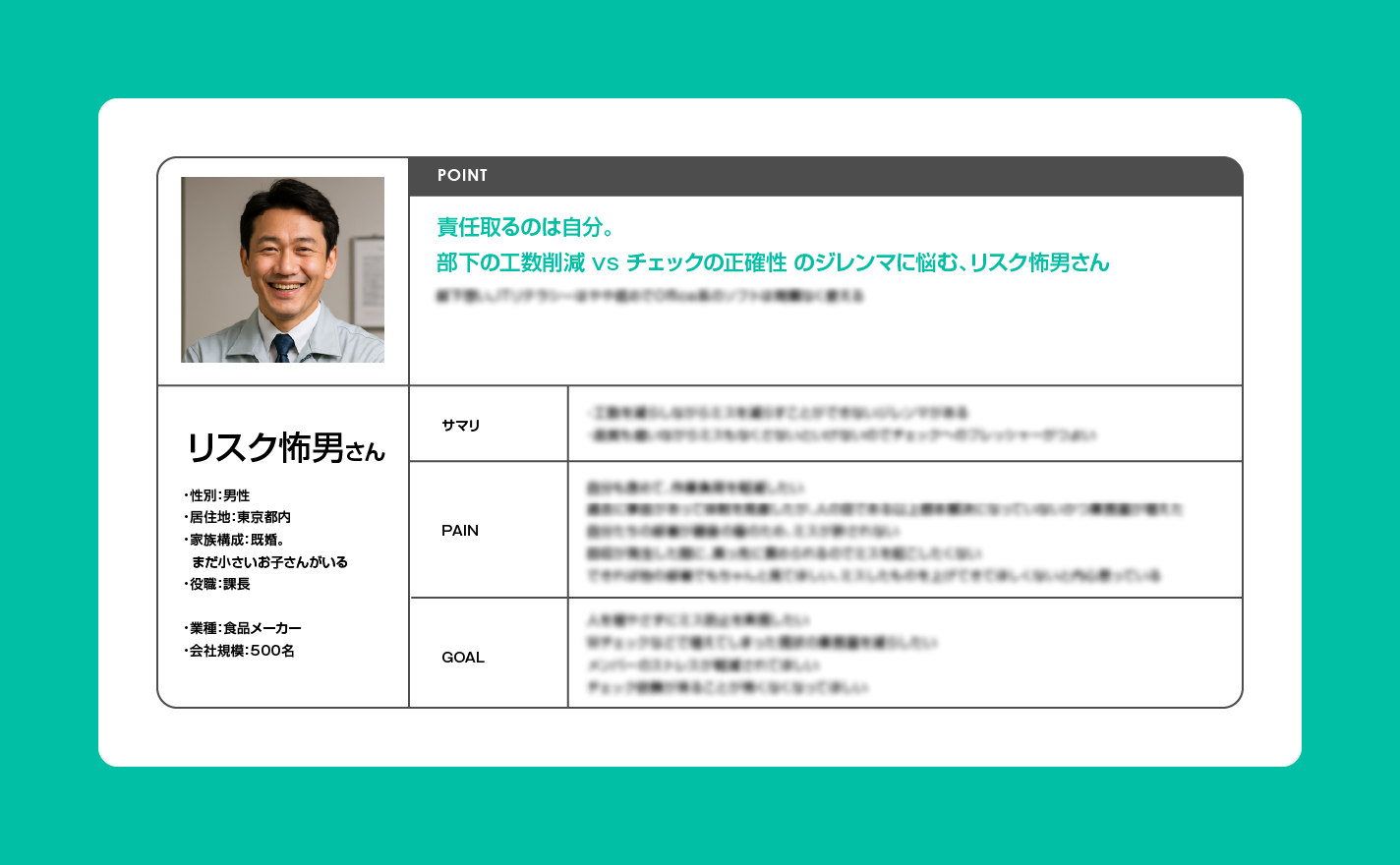
A Three-Year Growth Plan Starting from the Personas "Takako the Motivated" and "Kowao the Risk-Averse"
In the course of this vision formulation, personas with visible faces were also born. Named "Takako-san" and "Kowao-san," these personas function not as mere abstract target users but as "personas with visible faces" — axes for concrete judgment, so that when a product issue is discovered, the team can ask specifically, "How would this be for Takako-san?"
After the vision and personas were set, discussion unfolded on how to grow the product from here. Starting from what would be needed for "Takako the Motivated" and "Kowao the Risk-Averse" to use the product, the desired states for years one through three were set. The team identified what must be done one year out to reach the third-year goal, and set priorities. Furthermore, state goals were set for each quarter within the year and translated into concrete action plans. "With the vision decided and our field of view opened up, the many variables that existed at launch were settled, and with more fixed values we knew where to commit. The PdM side also became easier to move, and with the product's destination visible, 'where we go to market' became extremely clear." (Hirano, TOPPAN Digital) By flexibly combining workshops and discussions as means, the team was able to rapidly draw a business growth strategy that guarantees consistency between business and product.
Connecting Business and Product Strategy Through the Co-Creation of PdM and PMM
The greatest distinguishing feature of this project lies in the effective connection of business strategy and product strategy through the co-creation of PdM and PMM. From a situation in which the business side and the product side moved separately with misaligned perspectives, the PMM took on the role of bridge between the two, adjusting each other's viewpoints and priorities. The PMM defined the STP and organized the business strategy and market needs. On that foundation, the PdM built the development structure and implementation plan. This collaboration made it possible to move forward under data-based decision-making and shared understanding. Going forward, "review-it! for Package" aims to evolve from a tool for checking package back panels into a service where the checking work is completed from start to finish — useful to everyone involved in checking work. The structure in which PdM and PMM watch each other's backs and support the product from both the business and product sides will be a key element in making that evolution certain.
Client's Voice
Our division had set out a strategy of expanding our business domain from "contract development for individual companies" to "product development for the market," but the following three points were challenges:
(1) Organizational support for developing PdMs (PdMO) (2) Dividing up the overly broad PdM role (a PMM you can trust with your back) (3) Strengthening UX design, which is growing in importance in BtoB products (from manufacturing quality to quality in use)
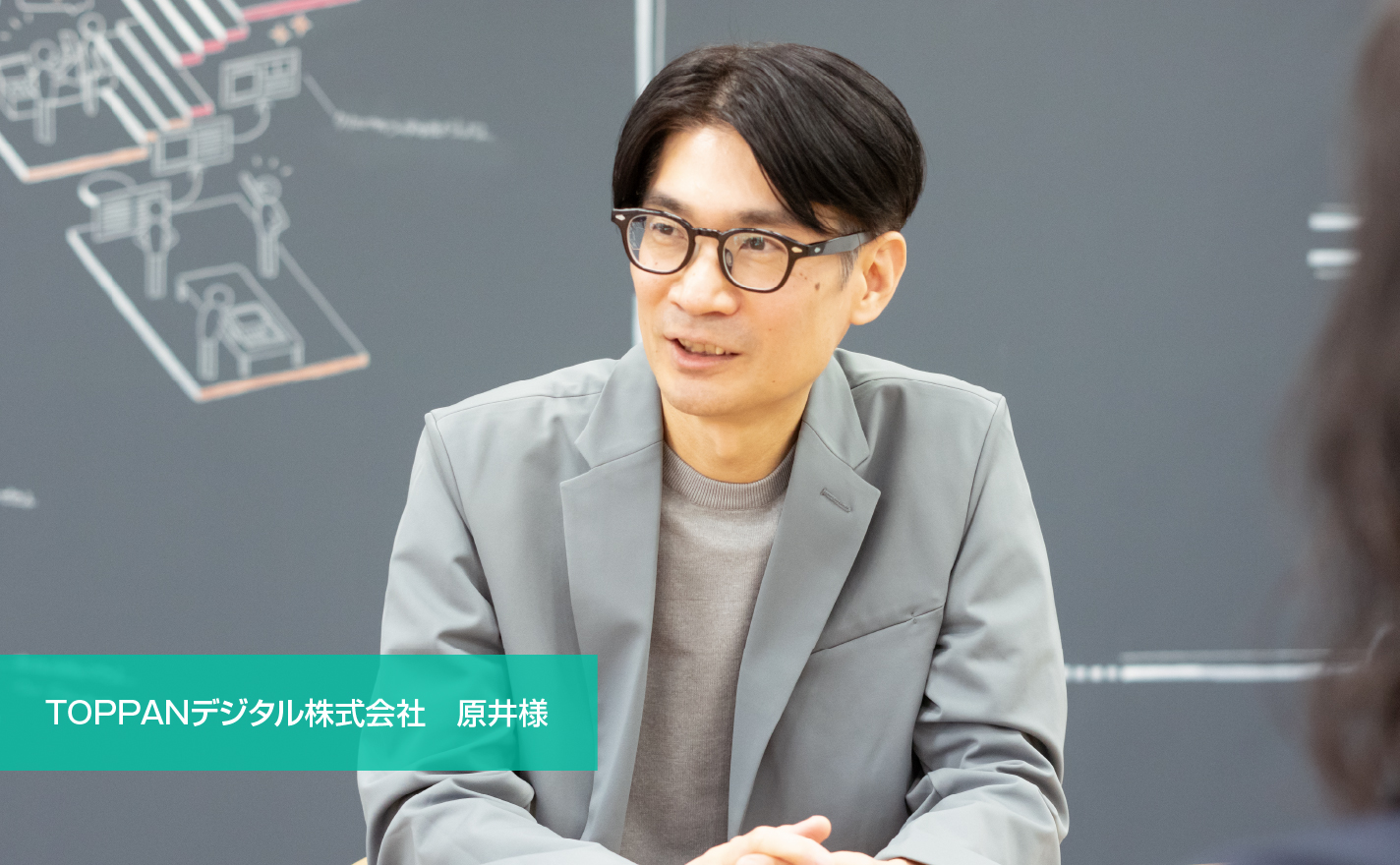
Goodpatch's support service "Product Growth Partnerships" was an ideal service that could comprehensively solve these three challenges, and it struck deep at our needs. What I felt through the year of support is: "professional, and by our side." I am deeply grateful for the reassuring support of every member. Everyone receiving the support is experiencing "personal growth," and I too hold great expectations for "achieving both personal growth and business growth"!
— Harai, TOPPAN Digital Inc.
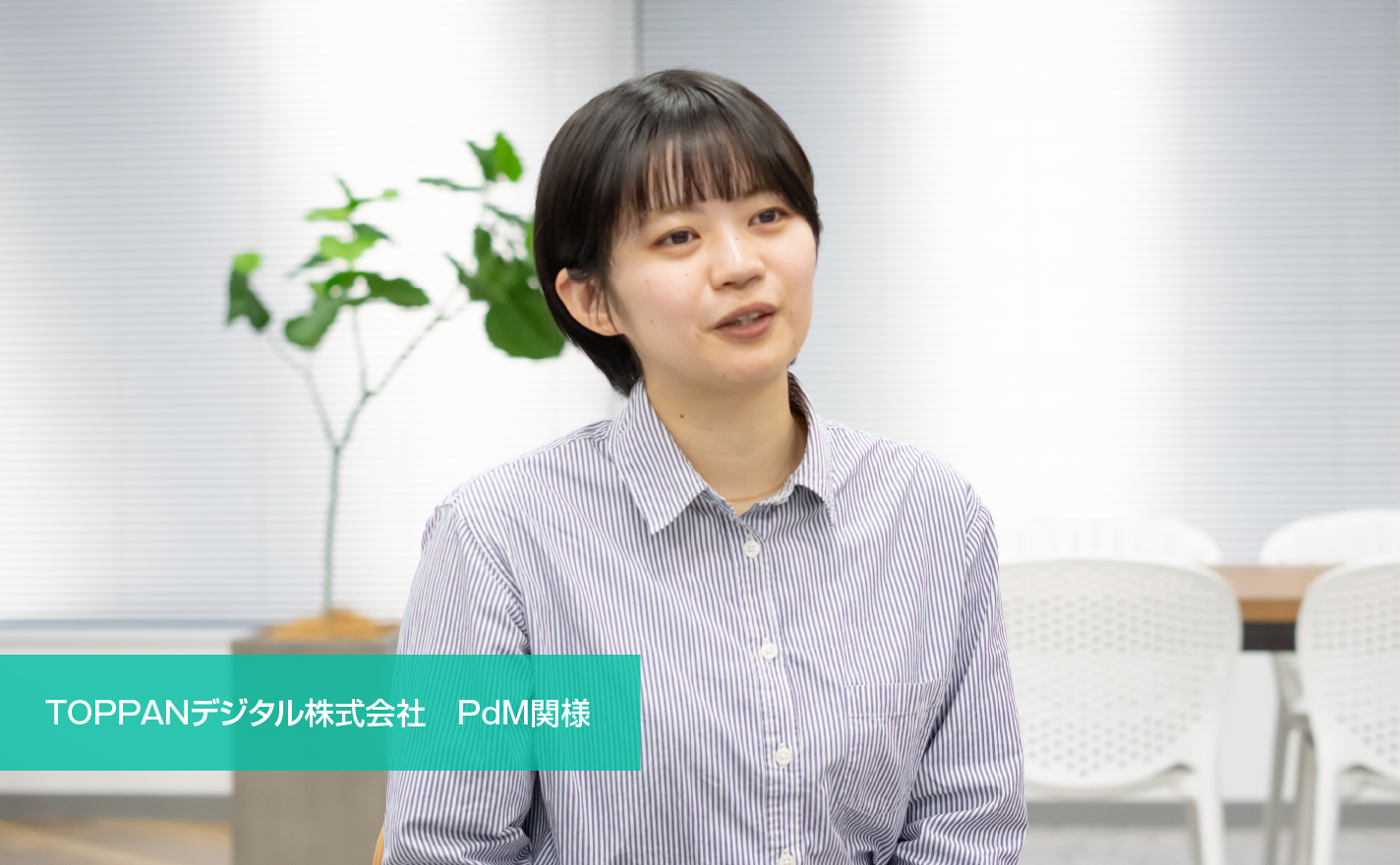
Thank you for your support! I feel that the visualization of metrics and the formulation of the vision created strong linkage in an organization where the business unit and the development unit had each been moving on their own. The direction the business is aiming for has also become clearer, so we will connect this to even greater results!
— Hirano (PMM), TOPPAN Digital Inc.
For me, with no experience in product management or development, they were a truly invaluable presence. Thanks to their organizing what needed to be done from an objective standpoint, I was able to work with speed. I will make the experience of this support my nourishment, study harder, and grow the product. Thank you!
— Seki (PdM), TOPPAN Digital Inc.
Further details of this project are available in these interviews: A Community That Connects and Develops Isolated PdMs: The Story Behind the Launch of TOPPAN Digital's "PdM Committee" The Key Is the "Division and Collaboration" of PdM and PMM — The Ideal Product Growth TOPPAN Digital Is Searching For

Credit
Supervision: Kazuyuki Tomita
Quality Manager: Kenji Ishida
Product Manager: Shumpei Kano
Product Manager: Kohei Sumioka
Product Marketing Manager: Saki Yoshida
Software Engineer: Shuhei Kotegawa
Software Engineer: Kantaro Kadota
Software Engineer: Yuta Minomo
Designer: Takuya Yabuki
Account Manager: Fumiyasu Urata
Inquiries about this project
For questions or consultations about this project, please feel free to reach out using the form below.





Get In Touch
Talk to us about anything—UI/UX design for services and products, brand building, AI adoption, new business development, or management and business strategy.