- Client
- JINS HOLDINGS Inc.
- Expertise
- DX Support
- Date
Overview
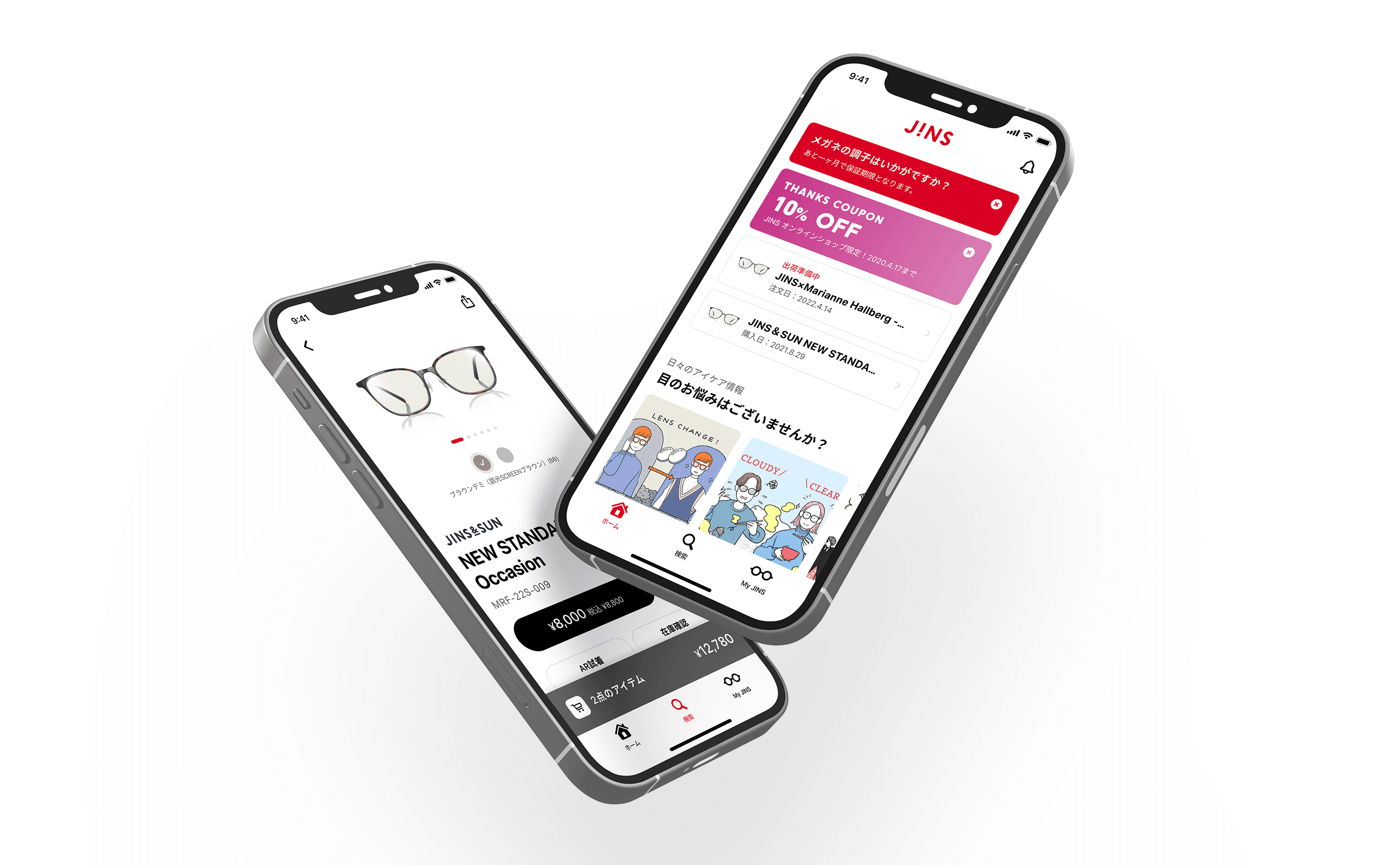
Goodpatch supported the renewal of the official JINS app used at stores nationwide. Working directly under management, we reexamined the structure of the application — which encompasses the offline experience including stores, as well as web and e-commerce functions — and formulated personas, experience design, a UX concept, UI design principles, and the app design image. This article introduces part of the process of how we approached the experience design of OMO, one of today's major trends.
Summary
Client needs
- Update the app to be as easy as possible for customers to use, while taking into account the operational load on stores and the constraints of existing systems
- Clarify the value the app provides within the overall JINS service, based on users' challenges and the company's own analysis
- Embody the "zero waiting time" goal set out in the management policy by conceiving a purchase experience that links stores, web pages, and the smartphone app
Goodpatch's approach
- Extracted customer experience issues from interviews with customers and management
- Designed the ideal customer experience (the app's experience concept) through the creation of customer personas and customer journey maps
- Formulated a phased renewal roadmap and delivered app UI designs linked with content and stores
- Formulated UI design principles and design guidelines to serve as a compass for ongoing renewal
Future plans and current results
- Over 14 million cumulative downloads
- App Store rating improved from 2.1 to 4.6 (as of December 2023)
Background of the Request and the Project Plan
Since opening its first store in 2001, "JINS" has long led the "low-priced eyewear" market. In recent years, low-priced eyewear — the so-called "three-price glasses" — has become established in the industry, and price competition has intensified.
What JINS HOLDINGS focused on for differentiation was the user's "purchase experience." To embody the "zero waiting time" goal set out in its management policy, the company commissioned the project to Goodpatch. It began with the request to conceive a seamless purchase experience linking stores, the web, and the smartphone app, and to make proposals that also take implementation into account.
With many vendors involved in developing the application, the roles of the web and the app had become ambiguous, so the project started from establishing a policy for how to improve them anew.
Creating Personas and Customer Journey Maps to Design the Ideal Customer Experience
Persona formulation
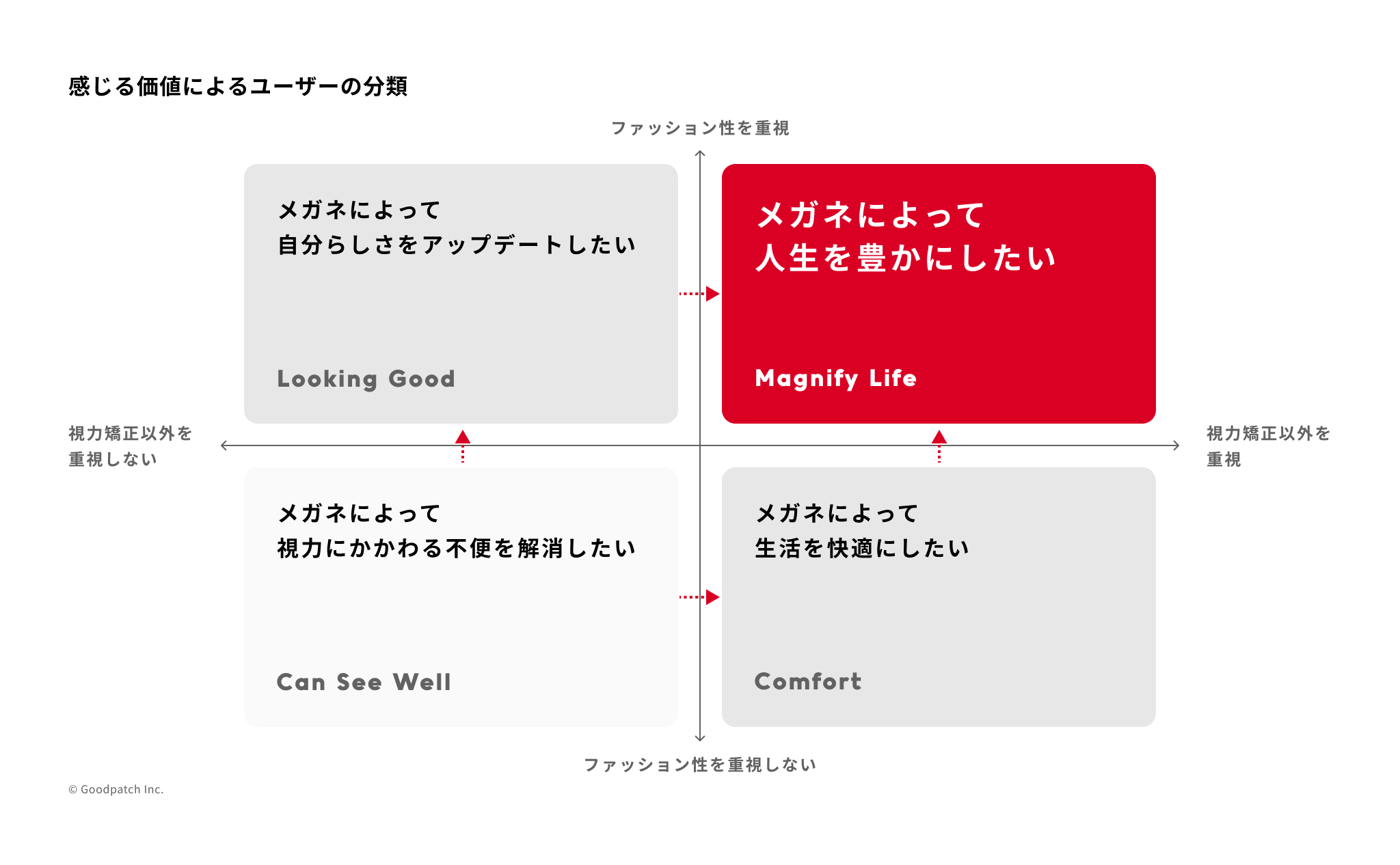
To scrutinize the customer experience JINS aims for, we began by formulating personas. Through interviews with a total of 15 people, we deepened our understanding of eyewear users while defining four types of user that JINS particularly wants to build relationships with going forward:
- Those who want glasses to resolve inconveniences related to eyesight
- Those who want glasses to make life more comfortable
- Those who want glasses to update their sense of self
- Those who want glasses to enrich their lives
The basic policy for service design was to satisfy the needs of the lower-left segment — the volume zone of current JINS users — while designing measures to move users toward the lower-right and upper-left segments.
Concepting the experience JINS as a whole provides
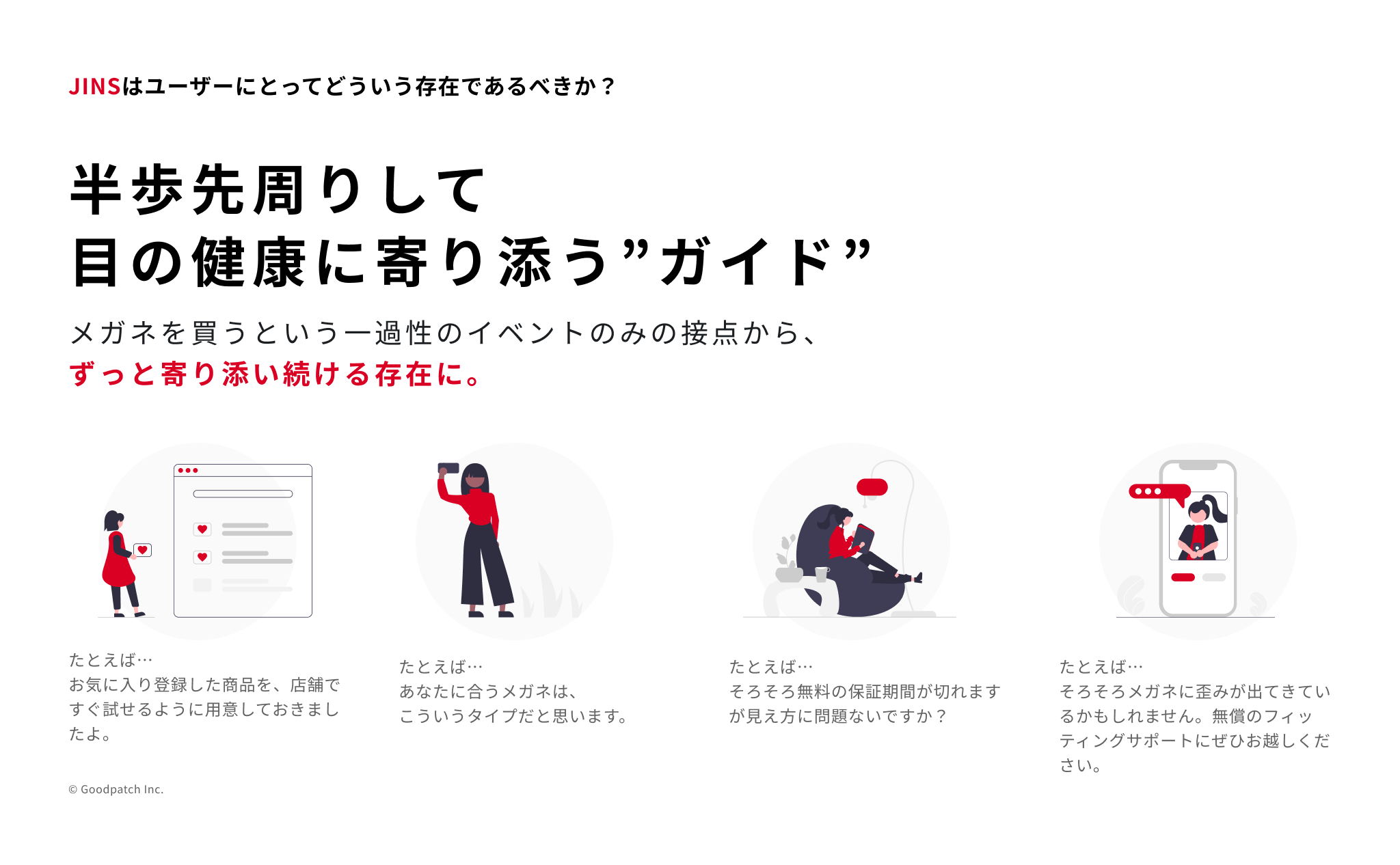
Integrating the operator's aim of "increasing contact with users beyond purchase occasions and fostering loyalty" with the user's wish "to resolve inconveniences related to eye health within the natural flow of daily life," we defined the concept of the experience JINS as a whole provides as "a guide that stays half a step ahead, close to your eye health."
Formulating the App Renewal Policy
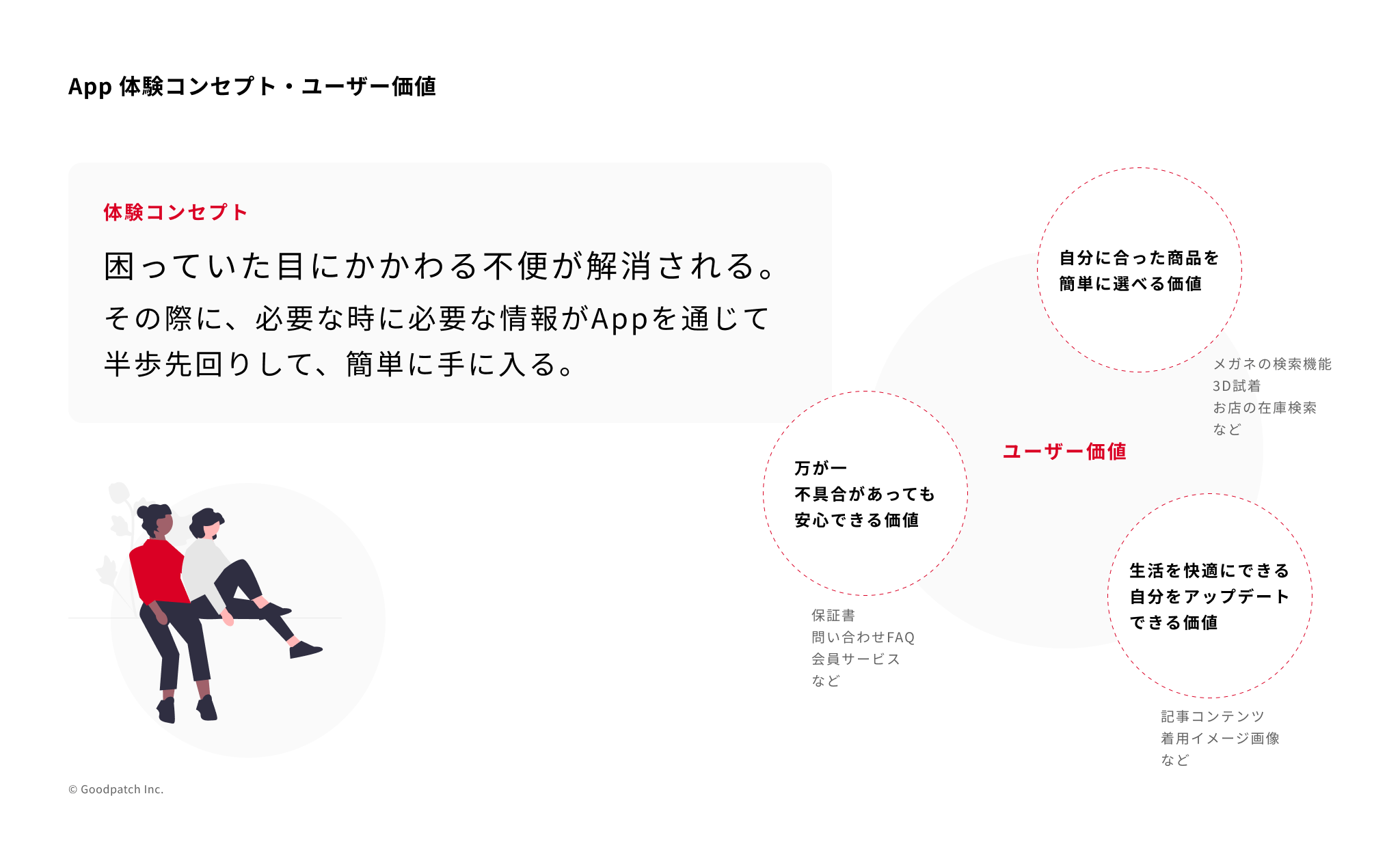
After defining the ideal customer experience, we considered the renewal policy for the smartphone app. Starting from the experience JINS as a whole provides, we first defined an app experience concept that satisfies the needs of all personas.
Until then, the main occasions for opening the app had been limited to two: "showing the membership card at purchase" and "showing the warranty when visiting a store due to a defect or damage to a purchased item." In this renewal, we aimed to newly establish impressions matching users' latent needs —
- "If something ever goes wrong, let's open it"
- "Looking at it might make life more comfortable, or update me a little"
- "It seems easy to find products that suit me"
— and connected them to user scenarios aligned with usage occasions.
At the same time, to consider the issues and policies for implementing the renewal, we surveyed the existing app. While the necessary and sufficient features were implemented, we also found issues:
- The design did not match the latest design guidelines and tone and manner
- The launcher-style UI required users to actively go and fetch information
- The app did not follow OS guidelines
In this renewal, therefore, we set a development policy of avoiding a focus on new feature development and prioritizing the creation of a foundation for realizing the experience concept over the long term.
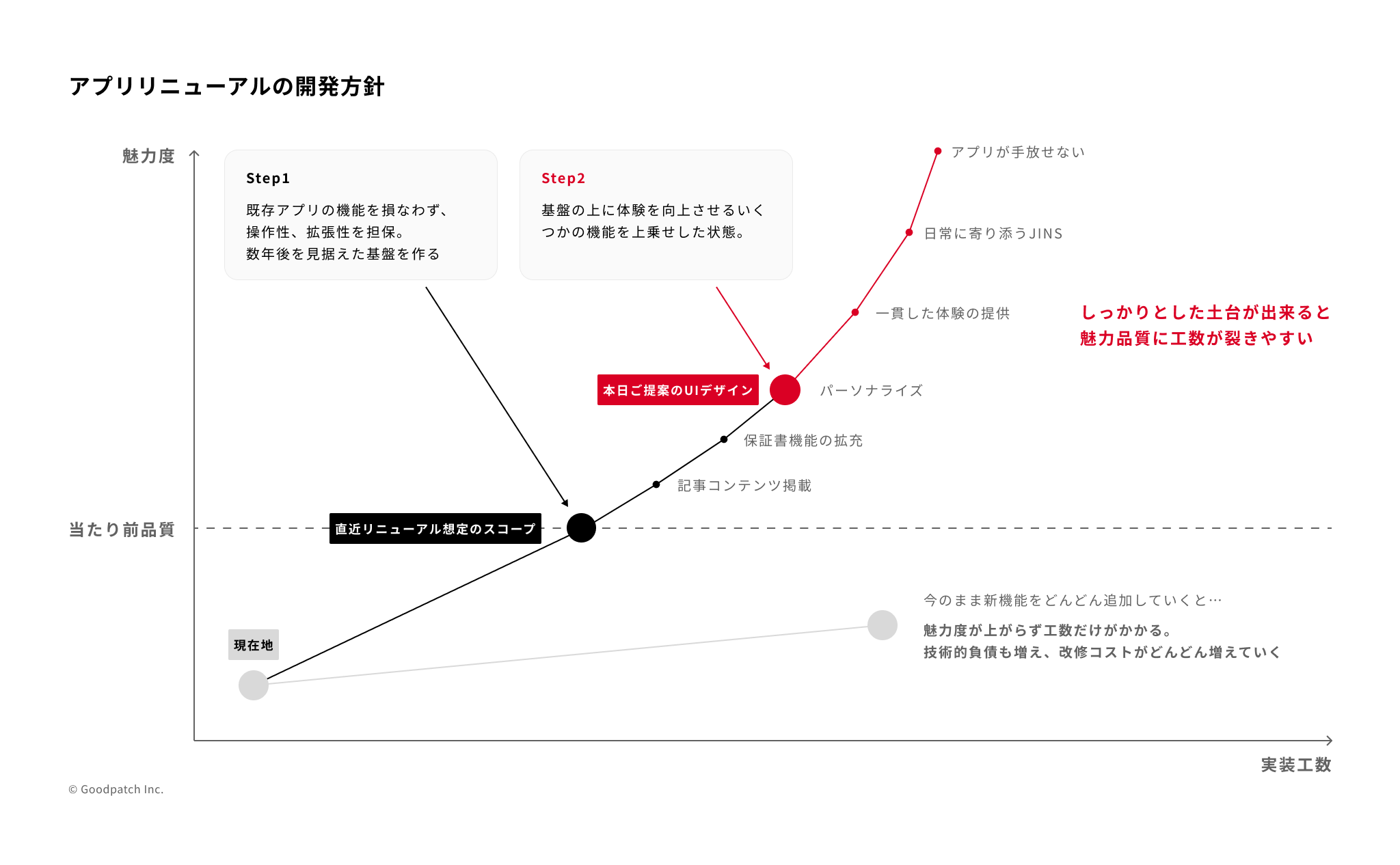
App Design and Guidelines with Medium-to-Long-Term Improvement in View
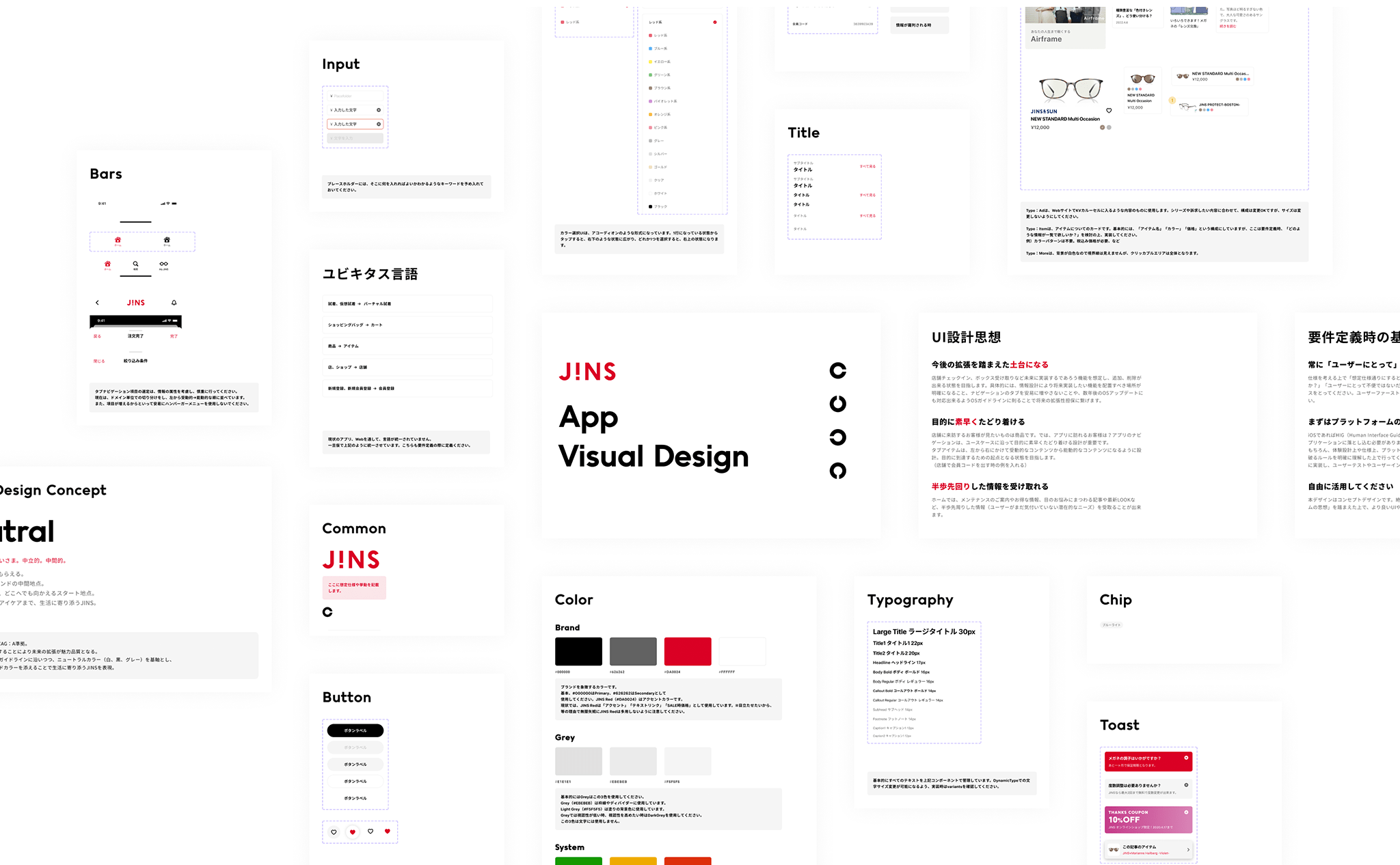
For the post-renewal UI, we defined the app's own visual design concept, UI design principles, colors, and components so that consistency can be firmly maintained in future updates and feature additions.
By writing usage rules and UI thinking into the components, we aimed for a state in which communication as the JINS brand is firmly realized no matter who looks at them. We also gave consideration to accessibility, aiming for the conduct befitting "JINS as the brand of the eye."
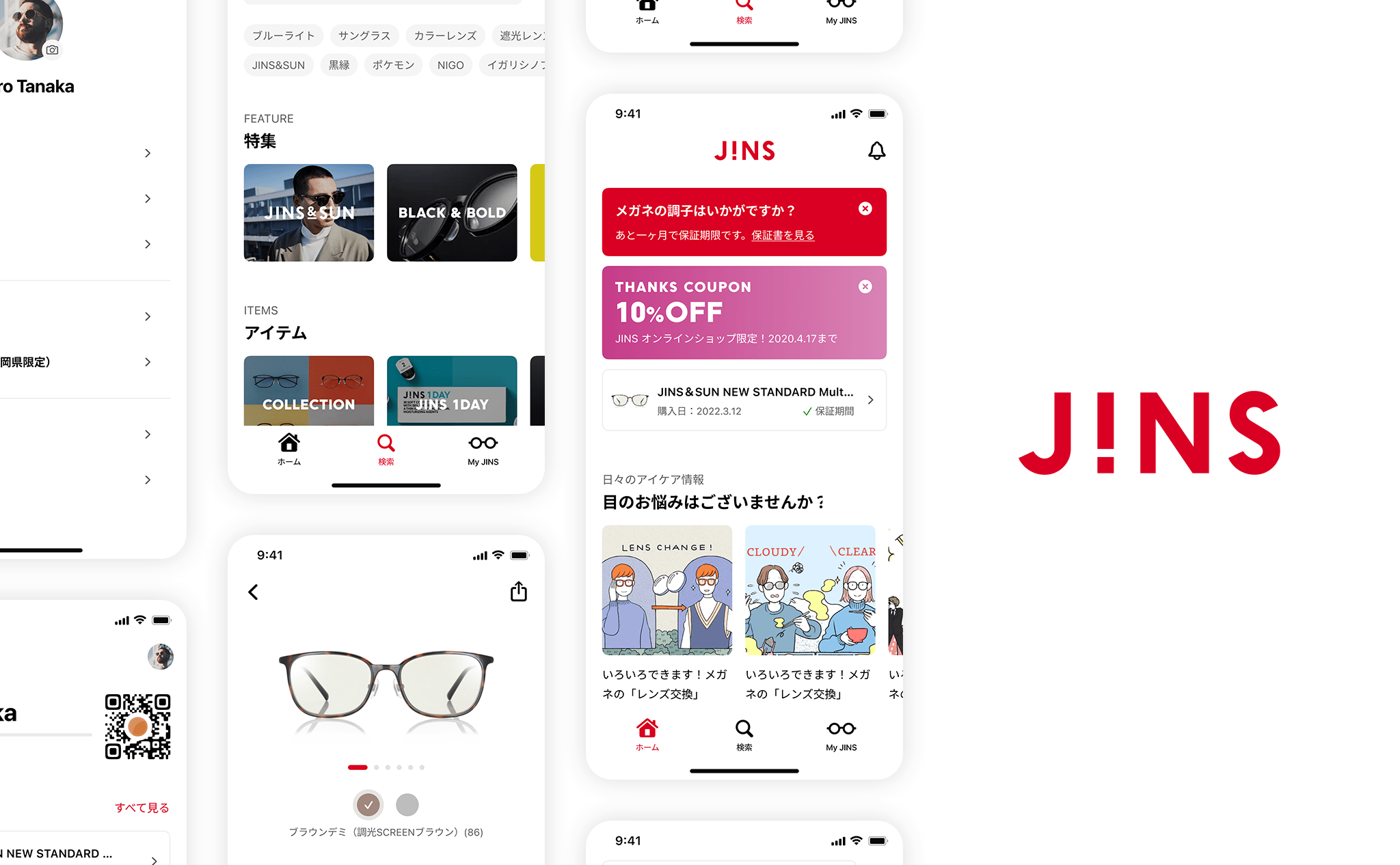
In the new UI, the top page was changed from a launcher type — where users had to actively grab information — to a dashboard type, allowing users to receive the information they want passively. This also makes it easy to add the personalized display features and half-a-step-ahead information features envisioned for the future.
We also devised the information architecture so users can reach their goals quickly. For example, the tab navigation is designed so content moves from passive to active from left to right, functioning as a starting point for reaching one's goal. The validity of the design was confirmed by prototyping based on user scenarios, checking that the flow of the experience was smooth as we proceeded.
Finally, JINS implemented the app in-house based on the guidelines and released the renewed app in December 2022. The App Store rating is now higher than before the renewal, and we hear that negative comments from stores about the app being hard to use have decreased. The app has become easier to view and understand for more customers.
Credit
Project Manager: Masato Hattori
Design Strategist: Yuki Matsuo
UX Designers: Shunsuke Kitahama, Mika Ehara
UI Designers: Ryota Kanabuchi, Takumi Minemura
Account Manager: Fumiyasu Urata
Project Supervision: Kenichi Nakamura, Toru Kurita
Inquiries about this project
For questions or consultations about this project, please feel free to reach out using the form below.






Get In Touch
Talk to us about anything—UI/UX design for services and products, brand building, AI adoption, new business development, or management and business strategy.